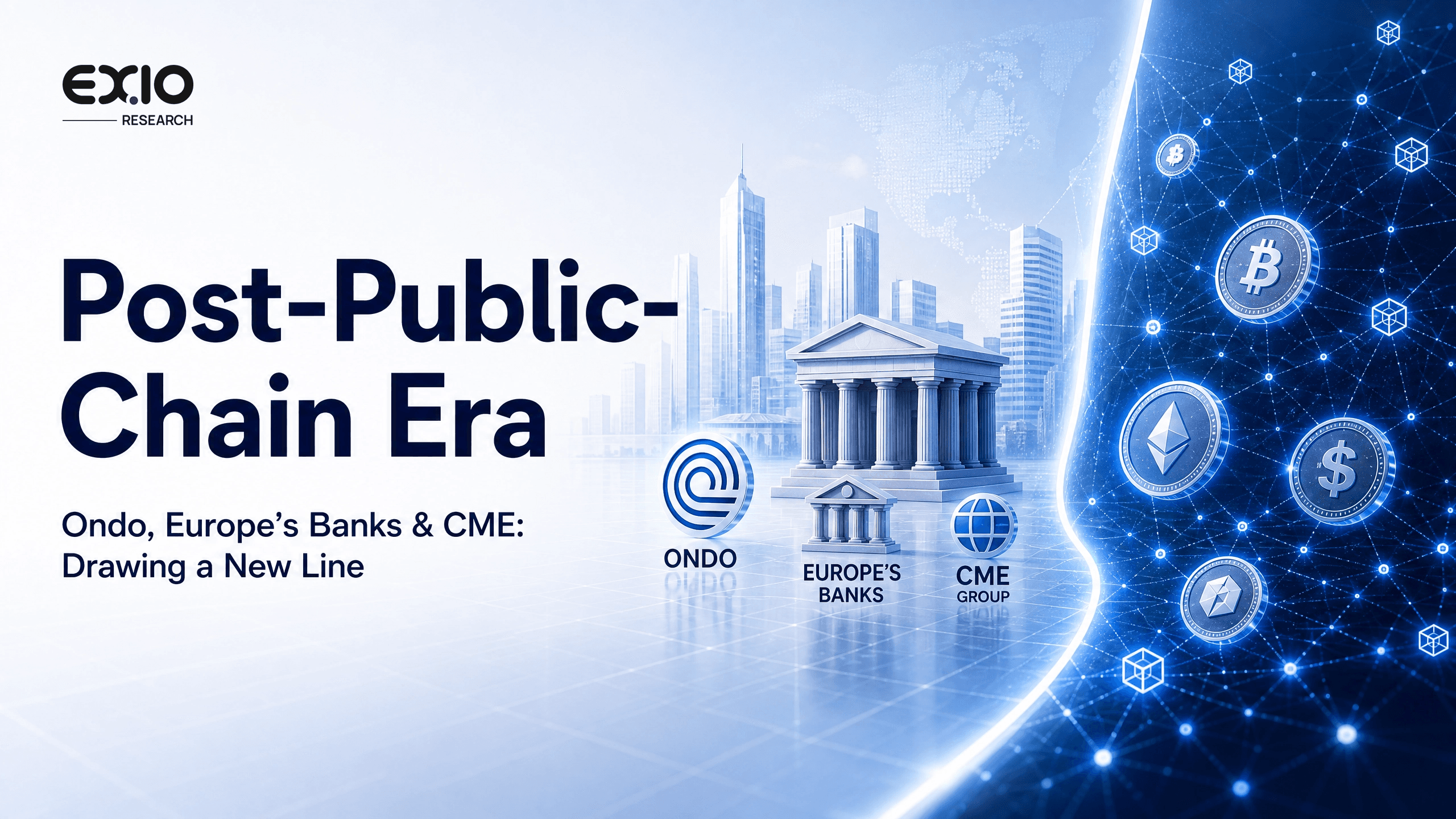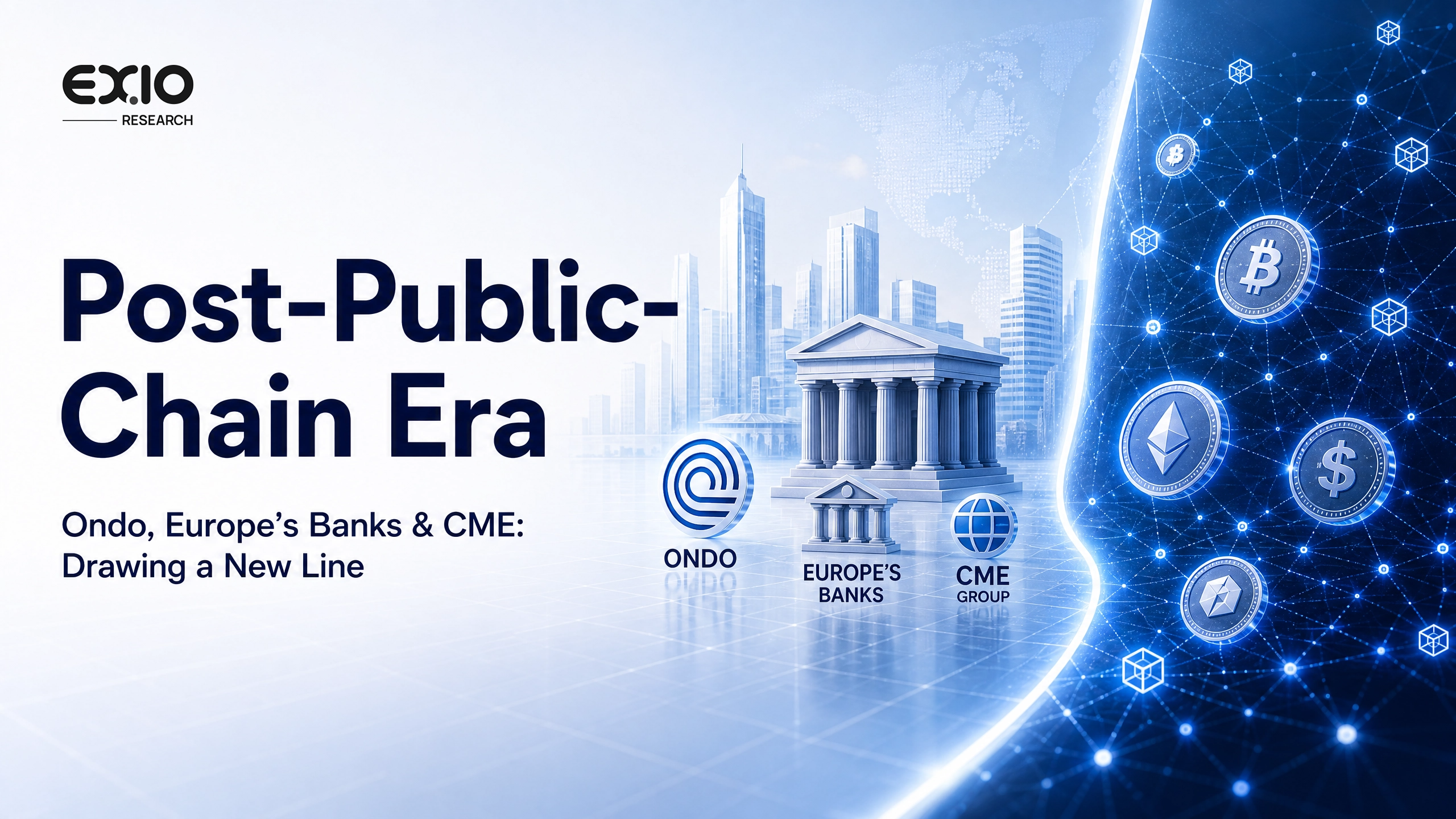
The Post-Public-Chain Era: Wall Street Just Announced It’s Building Its Own Blockchains — All on the Same Day
EXIO Research Institute | July 29, 2026
Three things happened on Monday, July 28, 2026. Ondo Finance — the firm managing $2.6 billion in tokenized U.S. Treasuries and $850 million in tokenized equities — announced it was abandoning its much-hyped Layer-1 blockchain. Not to upgrade it. Not to pivot to a different public chain. To build a private, off-chain high-speed trading network that deliberately keeps execution away from public blockchains.
On the same day, ten European financial institutions — including ABN AMRO, DekaBank, Natixis CIB, and DZ BANK — launched RL1 (Regulated Layer One), a jointly owned, permissioned blockchain cooperative designed to replace fragmented DLT experiments with a single, bank-controlled network for tokenized assets, digital money, and settlement.
And in Washington, the CME Group — the world’s largest derivatives exchange — was in federal court suing its own regulator, the CFTC, to block on-chain perpetual futures from being offered on public blockchain infrastructure.
Individually, each story is significant. Together, they represent something structural: institutional finance is systematically building infrastructure that doesn’t depend on public blockchains. The era of “just deploy on Ethereum and wait for institutions to come” is over.
The Three Shots
1. Ondo: The RWA Leader Walks Away
Ondo Finance didn’t just cancel a blockchain — it published a thesis.
In February 2025, the company announced Ondo Chain: a “blockchain for institutional finance and tokenized real-world assets.” The vision was clear: a public-chain-compatible Layer-1 purpose-built for Wall Street. Eighteen months later, after building its perpetual futures platform Ondo Perps, CEO Ian de Bode reached a conclusion that the firm stated publicly:
“A traditional blockchain wasn’t the best tool for handling the speed and privacy institutional trading requires.” [1]
The replacement — Ondo Network — is architecturally revealing. It splits trade execution from settlement: orders are matched and executed privately at high speed, while finalized asset transfers settle on public blockchains. The private layer handles what matters to traders (speed, confidentiality, front-running protection). The public layer handles what matters for audit trails (immutable settlement records).
This is not “Crypto 2.0.” This is the same architecture that traditional exchanges have used for decades — a central limit order book with blockchain-based settlement receipts. Ondo has simply acknowledged what many in the tokenization space have been quietly concluding: public blockchains are excellent settlement layers, but they are not — and may never be — competitive execution venues for institutional trading.
The numbers behind this pivot matter. Ondo is not a startup with a whitepaper — it has $2.6 billion in tokenized Treasury products (OUSG, USDY) and approximately $850 million in tokenized equities, according to rwa.xyz. Its broker-dealer received FINRA approval last week to launch regulated markets for tokenized securities. When the largest non-bank issuer of tokenized real-world assets says “public blockchains aren’t the answer for execution,” the market listens. [1]
2. RL1: Europe’s Banks Build Their Own Railway
If Ondo represents a single firm’s strategic about-face, RL1 represents an entire continent’s banking sector making the same bet — collectively.
RL1 (Regulated Layer One) launched on July 28 as a European Cooperative Society based in Luxembourg. Its ten founding members — ABN AMRO, Cecabank, Chartered Investment, Crédit Mutuel Alliance Fédérale, DekaBank, DZ BANK, LBBW, Natixis CIB, SC Ventures, and Seturion — each hold equal governance rights over a permissioned DLT network designed to replace the fragmented blockchain experiments proliferating across European banking. [2]
The network runs on infrastructure originally built by German fintech SWIAT, which has already processed over 50 transactions worth more than €700 million (~$808 million) during three years of production use. Additional institutions — including NatWest, KfW, and L-Bank — are in active discussions to join. [2]
What RL1 represents is not just another blockchain consortium. It’s an explicit rejection of the “public chain as universal infrastructure” thesis. The founding document is clear: RL1 exists to “overcome the current fragmentation of blockchain networks within the regulated financial sector and to create a neutral, member-owned, pan-European DLT utility.” [2]
Key word: member-owned. Not permissionless. Not open-access. Not decentralized governance by token holders. This is a cooperative — the same legal structure European banks use for shared ATM networks and payment clearing systems. Blockchain technology, bank-grade governance.
RL1 also explicitly ties itself to the European Central Bank’s DLT initiatives — including Appia (wholesale CBDC settlement) and Pontes (DLT interoperability) — signaling that the infrastructure being built is designed as a regulated rail, not a DeFi alternative. [2]
3. CME vs. CFTC: The Incumbent Draws a Line
The third shot came from Chicago, not Europe.
CME Group — the world’s largest derivatives exchange operator — is in the middle of an extraordinary legal battle with the Commodity Futures Trading Commission. CME sued the CFTC in June 2026, challenging the agency’s decision to permit Kalshi and Coinbase to list crypto perpetual futures. [4]
On the surface, this is a regulatory classification dispute: are perpetuals futures or swaps? But the substance of the fight reveals the same structural dynamic as Ondo and RL1. CME is not arguing that perpetuals are bad products — it is arguing that they should not run on infrastructure the CME doesn’t control.
CME Chairman Terry Duffy made this explicit in his Q2 earnings call, stating the exchange has “the full technical and operational capabilities to launch perpetual futures” but has “not heard demand from our customers for these products.” He described competitors’ perp markets as “an incubator system that I’m not paying for.” [4]
The subtext: CME wants perpetual futures, but on CME’s rails, under CME’s rules, with CME’s margin framework — not on Hyperliquid, not on a public blockchain, not even on CFTC-regulated Coinbase. The lawsuit is defensive infrastructure positioning, not a philosophical objection to the product design.
Meanwhile, DRW CEO Don Wilson — one of Wall Street’s most respected trading veterans — published a thread arguing that regulators are fundamentally misclassifying the product. “There’s no reason to treat perpetuals as swaps simply because they don’t expire,” Wilson wrote. “Economically, they’re futures.” His call: let perps trade on regulated venues, across all asset classes — commodities, securities, and crypto — but with proper risk management frameworks. [5]
The Wilson vs. CME split within Wall Street itself is telling. Both want regulated perps. One wants them on existing exchange infrastructure (CME). The other wants them wherever the technology works best (Wilson). Neither is arguing for permissionless, DeFi-native perps on public chains. The debate is not “public vs. private” — it’s “whose private infrastructure wins?”
The Common Thread: Three Converging Trends
Taken together, Ondo, RL1, and CME reveal three trends converging into a single structural shift:
Trend 1: Execution is decoupling from settlement.
All three cases share the same architectural principle: keep the public blockchain for final settlement (immutable record, audit trail) but move execution onto private, high-speed infrastructure. Ondo’s split execution/settlement design mirrors RL1’s permissioned network approach and CME’s existing market structure. The model is not new — it’s how every major stock exchange has worked for decades — but its application to blockchain-based assets represents a rejection of the “everything on-chain” maximalist thesis.
Trend 2: Governance is trumping permissionlessness.
RL1 is a cooperative. Ondo Network is centrally operated. CME is a listed company with a regulatory franchise. None of these entities is proposing a DAO, a governance token, or community voting. When institutional money decides to use blockchain, it brings its own governance model — which looks a lot more like SWIFT’s board than Uniswap’s.
Trend 3: The public chain’s role is shrinking to a settlement utility.
If execution moves to private infrastructure and governance stays with regulated entities, what’s left for public blockchains? Settlement finality. The public chain becomes a notary service — valuable, but commoditized. This is the nightmare scenario for L1 tokens whose valuation premium depends on being the “global settlement layer for all assets”: if settlement is the only function left, the fee capture shrinks dramatically.
Historical Context: The Quiet Buildout
What happened on July 28 was not a surprise to anyone watching institutional tokenization closely. The trend has been building for at least 18 months. Global market infrastructure operators and central banks have been developing DLT-based settlement platforms explicitly designed as regulated, permissioned networks — not as public-chain bridges. The ECB’s Pontes (DLT interoperability) and Appia (wholesale CBDC settlement) initiatives, multiple SWIFT-led cross-border DLT trials, and the DTCC’s production-grade tokenization platform all share the same architectural principle: blockchain technology deployed within existing regulatory perimeters, not on public networks. [2]
The July 28 announcements were the moment this quiet infrastructure buildout became visible all at once.
What This Means for the Tokenization Market
The Post-Public-Chain Era doesn’t mean public blockchains become irrelevant. It means their role in institutional finance becomes narrower and more specific:
For RWA issuers: The Ondo pivot sets a precedent. If the largest independent tokenized Treasury issuer concludes that public chains are inadequate for trading infrastructure, smaller issuers will follow. Tokenized assets may still be “issued” to public chains, but the venues where they trade, the collateral systems that support them, and the margin frameworks that govern them will increasingly run on private infrastructure.
For exchanges and trading platforms: The CME lawsuit signals that incumbent infrastructure will fight — legally, politically, and commercially — to ensure that any new product runs through regulated venues with established risk frameworks. The CFTC may be opening doors for on-chain perps, but CME’s lawsuit is a reminder that opening a door and walking through it are different things.
For public L1/L2 networks: The shrinking role thesis is a challenge. If institutional finance only needs public blockchains for settlement finality, the addressable market is smaller, the fee capture is lower, and the valuation premium for “global settlement layers” needs to be recalibrated. Ethereum, Solana, and other networks may find themselves competing for a settlement-only role rather than the full-stack financial infrastructure role many investors priced in.
For the competitive landscape in Asia: The RL1 model — a bank-owned cooperative DLT network — is replicable in other jurisdictions. An open question for the market is whether individual jurisdictions build their own RL1 equivalents or connect to existing networks. The HKMA’s Project Ensemble and its stablecoin sandbox are early indicators of which direction Hong Kong might take, but the race is accelerating.
Based on the converging evidence from July 28, EXIO Research Institute see four core judgments emerging:
1. The “institutions will come to public chains” thesis has been materially challenged.
For at least five years, the dominant crypto narrative held that institutional adoption would flow through Ethereum, Solana, and other public L1s. Ondo’s pivot — from a crypto-native RWA leader — is the most explicit repudiation of this thesis yet. RL1 confirms it at the multi-bank level. CME’s lawsuit confirms it at the exchange infrastructure level. Institutions are adopting blockchain technology. They’re just not adopting the public blockchains that crypto investors bet on.
2. The value chain is splitting into three layers.
What July 28 revealed is a clear three-layer architecture emerging for institutional blockchain: (a) Execution layer — private, high-speed, institutional-grade (Ondo Network, RL1, CME); (b) Settlement layer — public blockchains or regulated DLT for finality (Ethereum, Solana, RL1 ledger); (c) Governance layer — cooperative, bank-owned, or exchange-operated (RL1 SCE, Ondo corporate, CME listed entity). The layers are decoupling, and the economics at each layer are diverging.
3. Asia has a tactical window — but it’s closing fast.
With the U.S. CLARITY Act shelved and European banks already building their own infrastructure (RL1), Asia faces a strategic choice: join existing networks, build regional equivalents, or attempt to bridge public and private infrastructure. Hong Kong’s regulated exchange ecosystem and the HKMA’s tokenization initiatives give it a head start, but the RL1 model — a bank-owned, jurisdiction-spanning cooperative — is a template that ASEAN and the Gulf states can replicate within 12-18 months.
4. The regulatory vacuum is an infrastructure opportunity.
CLARITY Act’s failure means the U.S. lacks a federal framework for tokenized securities and exchange registration. But regulatory vacuum does not mean infrastructure vacuum — as Ondo, RL1, and CME demonstrate, private and consortium infrastructure is being built regardless. For jurisdictions with clear rules (Hong Kong, Singapore, EU under MiCA/DLT Pilot Regime), this creates a two-speed market: regulated venues with legal certainty on one track, private consortium networks on another.
The Post-Public-Chain Era thesis faces several countervailing risks:
Risk 1: Public chain technology catches up.
If Ethereum’s L2 ecosystem or Solana’s Firedancer upgrade delivers institutional-grade throughput, privacy (via ZK proofs), and MEV protection at competitive latency, the execution layer advantage of private networks could narrow. The question is timing: Ondo and RL1 are building now; public chain upgrades are on 12-24 month roadmaps.
Risk 2: Fragmented private networks create new interoperability problems.
RL1 is designed to solve fragmentation — but if every jurisdiction builds its own RL1 equivalent (one for Europe, one for ASEAN, one for the Gulf), cross-network asset transfers may require new bridging infrastructure that recreates the problems RL1 was designed to solve.
Risk 3: Regulatory pendulum swings back toward public chains.
The CFTC’s current stance favors on-chain perps (Kalshi, Coinbase approvals). If the CME lawsuit fails and the CFTC successfully establishes a framework for regulated on-chain derivatives, the “private infrastructure only” thesis weakens. A CFTC win would mean regulated public-chain products are viable, potentially reversing the Ondo/RL1 trend.
Risk 4: Tokenized asset liquidity remains concentrated on public chains.
Even if execution migrates to private networks, the majority of tokenized asset liquidity — and thus price discovery — may remain on public-chain DeFi protocols (Uniswap, Curve, Morpho). If private execution venues can’t match public-chain liquidity depth, the “execution decoupling” thesis could stall.
Bottom Line
The events of July 28, 2026 will be remembered as the day institutional finance stopped pretending it was going to migrate to public blockchains — and started building its own.
This is not a bearish signal for tokenization. If anything, the Ondo, RL1, and CME developments validate the thesis that blockchain-based financial infrastructure is inevitable — the question is who builds it, who owns it, and who captures the economics.
For the crypto industry, the message is uncomfortable but clear: the institutions are coming, but they’re bringing their own railway.
*Note: Throughout this article, terms such as “signal,” “indicator,” and “trend” are used as market observation language to describe observable industry developments, not as trading or investment signals.*
Reference
1. CoinDesk — “Ondo Drops Tokenized Asset Blockchain Plans for Private, High-Speed Trading Network” (July 28, 2026): https://www.coindesk.com/business/2026/07/28/ondo-drops-tokenized-asset-blockchain-plans-for-private-high-speed-trading-network
2. RL1 Official Press Release — “European Blockchain Initiative ‘Regulated Layer One’ Goes Live” (July 28, 2026): https://www.rl1.network/news/rl1-launch/
3. Cointelegraph — “European Financial Institutions Launch RL1 Cooperative Blockchain Network” (July 29, 2026): https://cointelegraph.com/news/european-financial-institutions-launch-rl1-blockchain
4. CoinDesk — “Inside the CME and CFTC’s Battle Over Onchain Perpetual Futures” (July 28, 2026): https://www.coindesk.com/policy/2026/07/28/inside-the-cme-and-cftc-s-battle-over-onchain-perpetual-futures
5. CoinDesk — “Wall Street Veteran Don Wilson Says Regulators Are Getting Crypto’s Biggest Trading Innovation All Wrong” (July 28, 2026): https://www.coindesk.com/markets/2026/07/28/wall-street-veteran-don-wilson-says-regulators-are-getting-crypto-s-biggest-trading-innovation-all-wrong
Disclaimer
This content is provided for general market information and educational purposes only and does not constitute investment advice, legal opinion, compliance advice, trading recommendation, solicitation or recommendation of any kind. This report consists of industry trend analysis and market information and does not constitute the provision of advice on securities or futures contracts under the Securities and Futures Ordinance (Cap. 571) (Type 4 and Type 5 regulated activities).
This report contains forward-looking statements that are subject to known and unknown risks, uncertainties and other factors. Actual results may differ materially from those expressed or implied in such statements.
This report is not prepared or distributed for residents of any jurisdiction in which the receipt of digital asset-related services is prohibited. Digital asset prices are highly volatile, and past performance is not indicative of future results.
Terms such as “signal”, “trend” and “indicator” used herein are market observation language describing observable industry developments and do not constitute any form of trading or investment signal. Readers should not make any trading, product, licensing or other business decisions solely on the basis of this content.
Where legal, compliance, tax or investment judgments are required, readers should consult qualified professional advisors.
Read more articles from the EXIO Research Institute.
Feel free to visit: https://www.ex.io/insights/category/research
Learn about EX.IO and explore our Hong Kong-leading compliant RWA product matrix: https://www.ex.io/rwa-market